
Who Eats Whom on the Riverbank
A snake swallows a frog in waterside undergrowth — this photograph from West Java shows a food chain that only runs on a riverbank that is still alive.
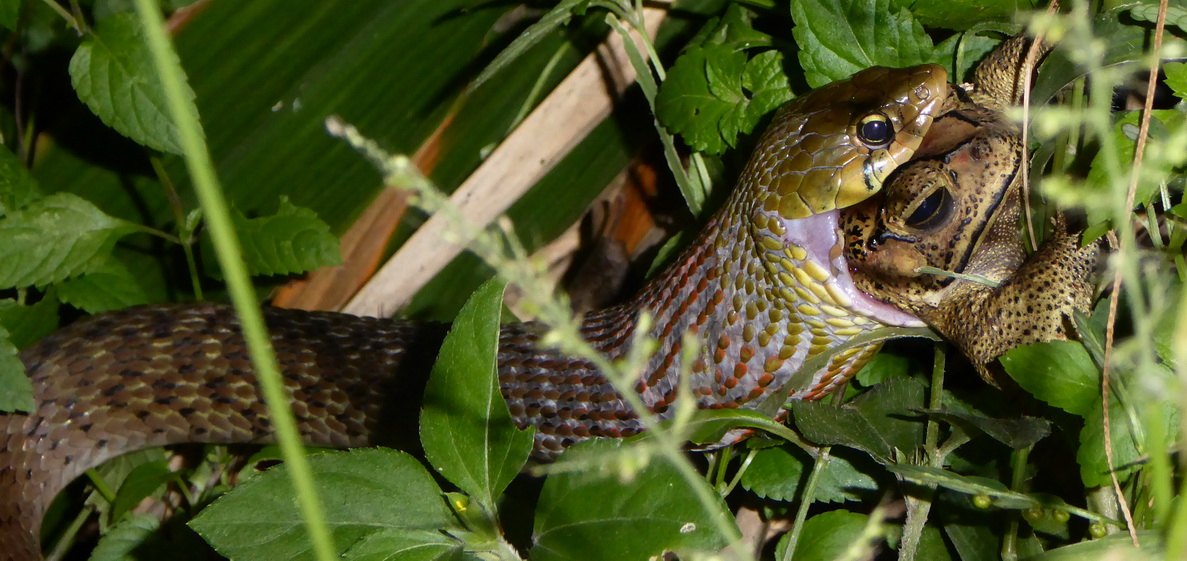
The photograph above was taken in West Java, in the area north of Bandung. A slender snake with a reddish neck is swallowing a frog in dense undergrowth. From the colour of its neck, our best guess is a keelback — a waterside snake of the family Natricidae. We write that as a guess: one photograph is not enough to be certain of a species, and we will not print a name we cannot stand behind.
Frogs live in two worlds: they lay their eggs in water, hunt insects on land, and breathe partly through their moist skin. Skin like that absorbs whatever is dissolved in the water — which makes frogs sensitive living indicators. A bank that still draws plenty of frogs usually still has decent water and cover.
For a snake, frogs are the staple food of the water's edge. A frog-eating snake can only live where frogs are plentiful — and frogs are plentiful only where the undergrowth is thick, the water is not too polluted, and their insect food is available. A single photograph of a snake eating a frog is really a report on three layers of life at once.
The chain does not stop at the snake. Kingfishers eat frogs, small fish, and occasionally young snakes; owls and eagles sit one level above them. Every level eats the level below, and all of it rests on the same thing: a bank that is grassy, bushy, and not cleared bare.
This photograph is not a record from Cipeuyeum — there are no verified records from our stretch yet, and we will not claim otherwise. But this is exactly the kind of event the River Calendar exists to catch: who eats whom, in which season, on which stretch. A food chain that is still complete is the simplest sign that a river is still working.